Complete Guide to Traveling from Thailand to Halong Bay - Plus Cruise Tips
- 1. Getting from Thailand to Halong Bay
- 2. Visa & Entry Requirements for Thai Travelers
- 3. Best Time to Visit Halong Bay
- 4. Choosing the Right Cruise
- 5. What to Expect Onboard
- 6. Practical Tips
- 7. Suggested Itinerary for Thai Travelers Visiting Halong Bay
- 8. International Cruises from Thailand to Halong Bay
- 9. Is a Halong Cruise Worth It?
If you’re looking for a destination that’s close to Thailand yet feels completely different, Halong Bay is hard to overlook. Unlike the familiar beaches of Phuket or Krabi, the bay is lined with limestone formations rising right from the water, creating a quieter and more distinct setting. This change of scenery brings a clear sense of “getting away” even on a short trip.
What draws many Thai travelers to Halong comes down to three things: direct flights to Hanoi that take just over an hour and a half, an itinerary that’s easy to fit into a short trip, and the experience of spending a night on a cruise — something you won’t find in many other places in the region. That’s why more and more visitors from Thailand choose Halong for a weekend getaway or as part of a Vietnam trip.
1. Getting from Thailand to Halong Bay
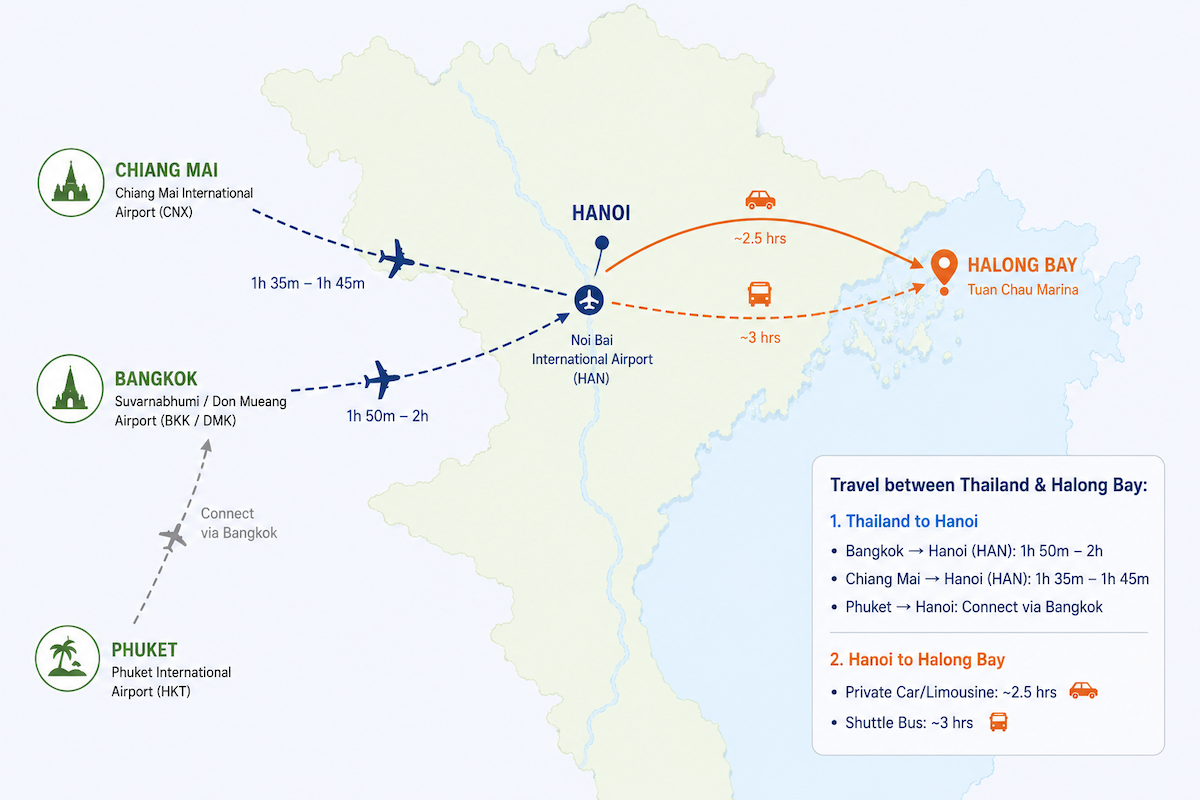
Flights from Thailand to Vietnam
You can fly directly from Bangkok (Suvarnabhumi or Don Mueang) or Chiang Mai (Chiang Mai International Airport) to Noi Bai International Airport (HAN) with airlines such as Thai AirAsia, Vietjet Air, Bangkok Airways, and Vietnam Airlines. The flight time from Bangkok is usually 1 hour 50 minutes to 2 hours, and from Chiang Mai is 1 hour 35 minutes to 45 minutes.
From Phuket, there are currently no frequent direct flights to Hanoi, but connecting through Bangkok is straightforward.
From Hanoi to Halong Bay
From Noi Bai Airport or central Hanoi, you have several options to reach Halong:
- Private car or limousine: The fastest and most comfortable option, taking around 2.5 hours via the Hanoi–Haiphong–Halong Expressway (QL5B).
- Shuttle bus: A more budget-friendly choice, around 3 hours, with pick-up usually in the Old Quarter.
Small tip: If you’re visiting Vietnam on a short trip, arranging a direct airport-to-Halong transfer from Noi Bai can save you valuable time.
2. Visa & Entry Requirements for Thai Travelers
Thai passport holders do not need a visa to enter Vietnam for short trips. Under the current policy, travelers from Thailand can stay in Vietnam for up to 30 days without applying for a visa in advance. This is one of the reasons why the Hanoi – Halong route is especially convenient for visitors from Thailand.
You must ensure that your passport is valid for at least six months from the date of entry. At Noi Bai Airport, you only need to show your passport and return ticket (or proof of onward travel). Immigration procedures are usually quick, especially for ASEAN citizens.
If you plan to stay in Vietnam longer than 30 days, work remotely, or need to enter and exit Vietnam multiple times during your trip, you can apply for a Vietnam eVisa (90 days, multiple entry) through the online portal. The process is straightforward and typically takes 3–5 working days to be approved.
Small tip: Even though you are visa-exempt, it’s a good idea to check the latest entry regulations before your trip, as policies may change. Keeping a digital copy of your return flight on your phone also helps speed up immigration at Hanoi Airport.
3. Best Time to Visit Halong Bay
If you’re coming from Thailand where the weather is warm year-round, the climate in northern Vietnam will feel quite different. From October to April, the weather is the most pleasant: cool, dry, and with clearer water conditions. Many Thai travelers prefer this period because the cooler air offers a refreshing change from Bangkok or Phuket.
From May to September, the temperature rises and there may be occasional heavy rain or short storms. However, this is also when the bay is quieter and cruise prices are usually lower, which works well if you prefer a calmer atmosphere or are traveling on a budget.
Certain peak periods like Christmas, New Year, and especially Lunar New Year tend to be very crowded with local travelers. If you plan to visit during these times, it’s best to book your cruise a few weeks in advance to secure good options.
4. Choosing the Right Cruise

Titop island is an iconic spot in Halong Bay route. (Photo: Ambassador Cruise)
2 Days 1 Night (2D1N) Cruise
If you only have 3–4 days in northern Vietnam, this is the option that fits best. A 2D1N trip covers the essentials like Sung Sot Cave, Titop Island, and a calm kayaking session giving you a good feel for Halong’s limestone landscape without taking too much time from the rest of your trip. Many travelers from Thailand choose this route because it works well for short holidays or quick weekend breaks from Bangkok.
3 Days 2 Nights (3D2N) Cruise
If you want a slower pace and more time on the water, the 3D2N itinerary is a great choice. It usually goes deeper into Lan Ha Bay or Bai Tu Long Bay, where there are fewer boats and the atmosphere is quieter. You’ll have extra activities like cycling in Viet Hai Village, visiting floating communities, and more time for kayaking or swimming.
This works well if you have about 5–6 days in the region and want the cruise to feel like a real break.
Luxury Cruises
Comfort is a priority for many Thai travelers, so higher-end cruises are often preferred. You can expect spacious cabins, private balconies, bathtubs with bay views, and sometimes extras like spa rooms, small pools, or gyms, depending on the boat.
Well-rated options that suit Thai guests include Stellar of the Seas, Capella, Orchid Cruises, and Heritage Line.
Mid-range & Budget Cruises
If you want a balanced option that doesn’t stretch your budget, mid-range cruises such as Peony, La Casta, Rosy, or Swan are solid picks. Cabins are clean and comfortable, meals are varied, and activities are well-organized.
They’re especially suitable for friends traveling together, couples looking for a value option, or families with older parents who want something simple and reliable.
5. What to Expect Onboard
Cabins:
Most cruises offer en-suite bathrooms, air conditioning, and large windows overlooking the bay. Some boats also have small balconies where you can sit with a cup of tea or watch the sunset. The rooms aren’t as spacious as hotel rooms on land, but they are clean and comfortable enough for a short stay.
Dining:
Meals usually combine Vietnamese seafood with dishes that suit a wider Asian taste, so Thai travelers generally find it easy to enjoy. Depending on the cruise, meals may be served as a buffet or set menu, and you can let the staff know if you prefer lighter spice or want to adjust certain dishes.
Activities:
Typical activities include kayaking, bamboo boat rides, cave visits, a cooking class, morning Tai Chi, and night squid fishing. Everything is simple and suitable for all ages, and you don’t need any special skills to take part.
Entertainment & facilities:
Most boats have a sundeck with loungers, a small bar, and open space for relaxing. Some higher-end cruises offer spa services, a small pool, or a gym, but many travelers simply spend time on the deck enjoying the quiet scenery of the bay.
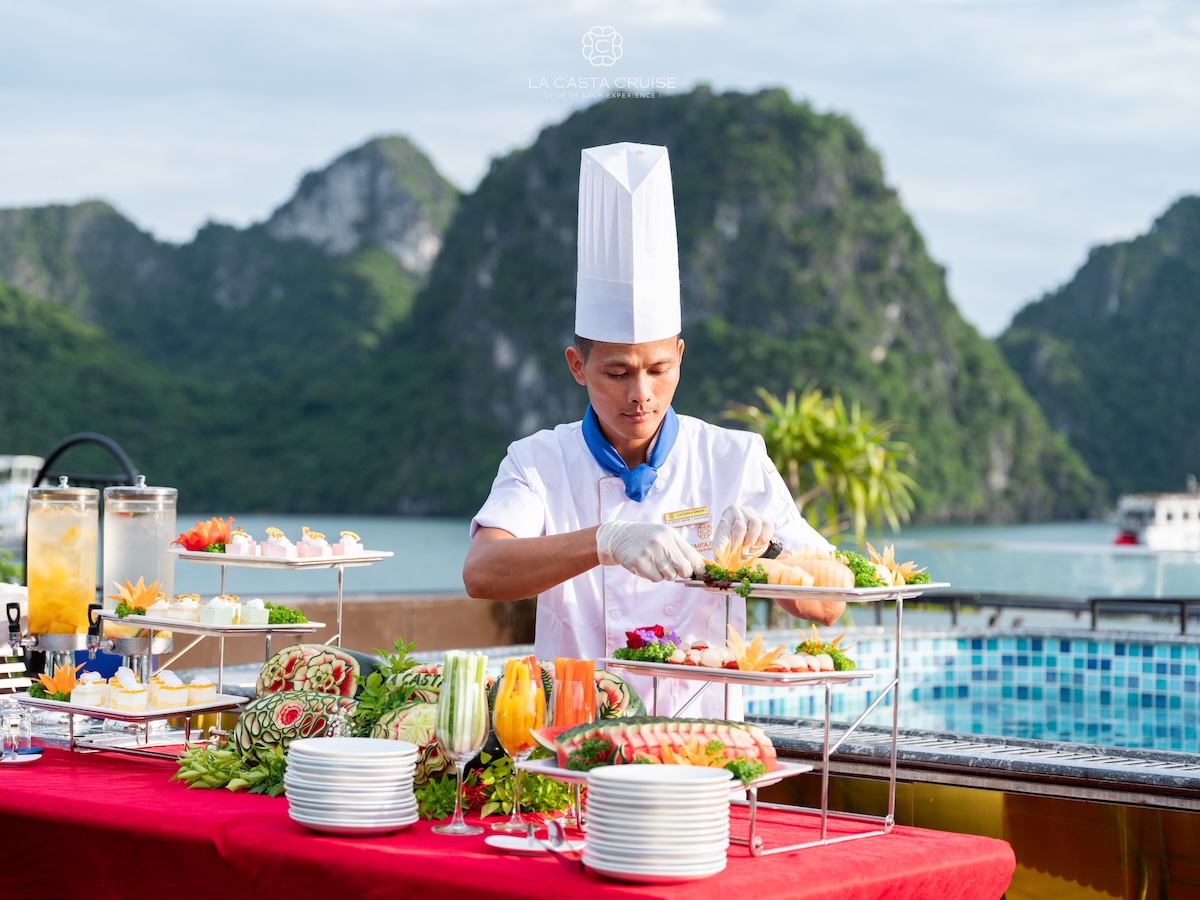
Preparing for a buffet dinner on the cruise deck. (Photo: La Casta Cruises)
6. Practical Tips
- When you travel in Vietnam, it’s easiest to pay with Vietnamese dong because most everyday places only take local currency. Some cruises let you pay by card at the end of the trip, but small things like drinks, snacks, or tips are usually paid in cash, so it’s good to exchange a bit of dong when you arrive in Hanoi.
- Vietnam uses several types of power plugs, mainly Type A, C, and D. Type C is the one you’ll see most often. Many cruises have mixed sockets, but not all, so bringing a universal adapter will save you trouble, especially if you carry a few devices.
- Halong Bay is generally calm, but if you normally get seasick, it’s better to pack some motion-sickness tablets. The boat can rock slightly when moving between islands. Safety rules are clear and straightforward, and you’ll always be given a life jacket for kayaking or boat rides, which helps you feel comfortable joining the activities.
- Having travel insurance is also helpful. The weather in northern Vietnam can change quickly, and sometimes cruises are delayed or cancelled because of storms. Insurance makes unexpected changes easier to handle, whether it’s your schedule or your health.
- Tipping isn’t required in Vietnam, but most travelers leave a small amount for the crew. It doesn’t have to be much, just a simple way to show appreciation for the people who take care of you during the trip.
7. Suggested Itinerary for Thai Travelers Visiting Halong Bay
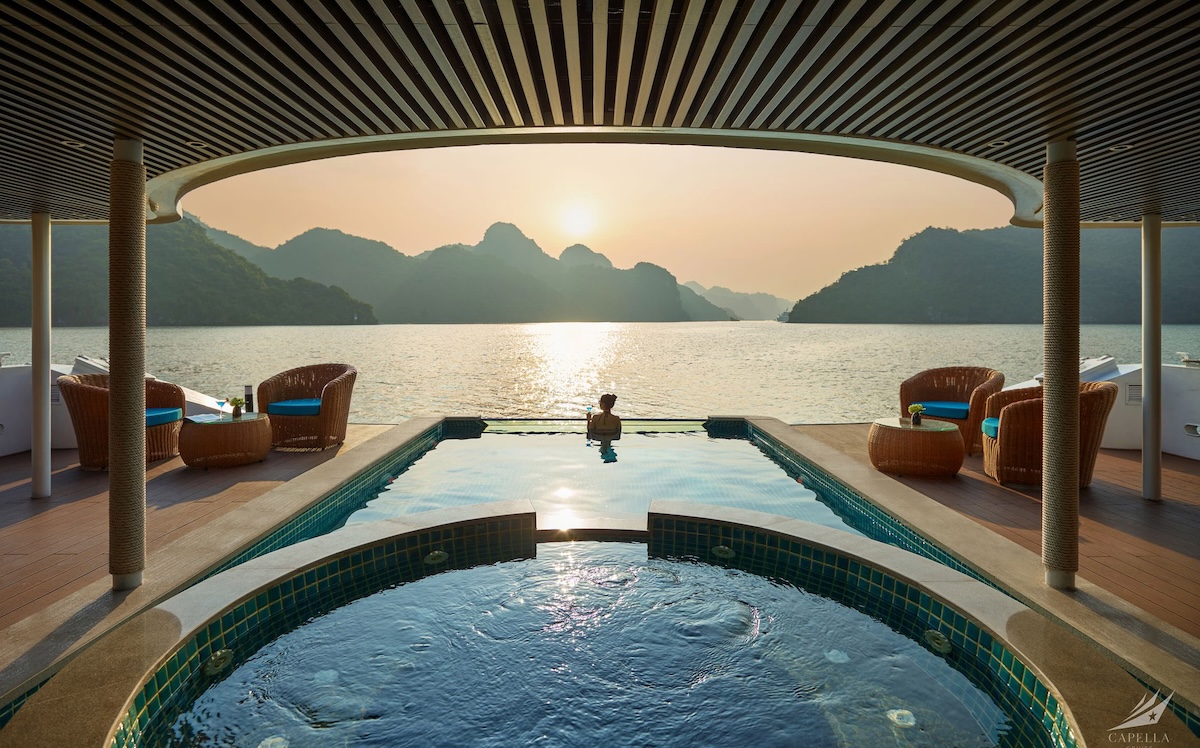
A swim with this view—nothing else needed. (Photo: Capella Cruise)
- Day 1:
If you’re coming from Thailand, most flights to Hanoi are short and quite convenient, so you can start your trip without feeling tired. On the first day, it’s best to settle into your hotel and take a light walk around the Old Quarter. Many travelers enjoy trying something simple like phở or bún chả for dinner before heading back to rest.
- Day 2:
Your second day can be spent exploring Hanoi at a relaxed pace. Places like Hoan Kiem Lake, St. Joseph’s Cathedral, or small cafés hidden in narrow lanes give you a good feel of the city. This slower day also helps you prepare for the cruise the following morning.
- Day 3 - 4:
On days three and four, you’ll head to Halong Bay for the overnight cruise — the highlight of the whole trip. Whether you choose a 2D1N or 3D2N itinerary, you’ll have time to kayak, visit caves, enjoy fresh seafood, and wake up to the quiet scenery of limestone cliffs. This part of the trip is usually the most memorable for travelers from Thailand.
- Day 5 - 6:
If you have more time, days five and six can be spent in Ninh Binh or Sapa. Ninh Binh is close to Hanoi and easy to reach, with rice fields and river landscapes that feel very peaceful. Sapa is farther but gives you cooler weather and views of terraced hills. Either option adds a different experience to your trip.
- Day 7:
On the final day, return to Hanoi, enjoy a simple lunch or do some last-minute shopping, then make your way to the airport for your flight back to Thailand. It’s a smooth, balanced itinerary that fits well into a short break without feeling rushed.
8. International Cruises from Thailand to Halong Bay
Thailand doesn’t offer direct cruise routes to Halong Bay, but it is included as one of the Southeast Asian stops on several long-haul East Asia cruise itineraries. These voyages are seasonal, not weekly services, and are usually operated by major international lines such as Viking Orion, ms Westerdam, Celebrity Solstice and Oceania Riviera.
On these itineraries, Thailand typically Laem Chabang or Phuket is simply one of many ports-of-call, and the ship may visit it either before or after northern Vietnam, depending on the route. Passengers usually join these cruises in larger regional hubs such as Hong Kong, Japan, or Singapore, rather than boarding in Thailand itself.
From Hong Kong, the sailing time to Halong is around one to two days at sea. When the ship arrives, most visits are day stops of about 6–10 hours, though a few extended voyages may include an overnight stay.
9. Is a Halong Cruise Worth It?
For travelers from Thailand, a Halong cruise is genuinely worth including in your Vietnam trip. The bay offers a landscape you won’t find at home quiet water, tall limestone cliffs, and a slower pace that feels refreshing. Because the flight to Hanoi is short, it easily fits into a long weekend or a short holiday without requiring much planning time.
Another reason it’s worth it is the overall value. Compared to cruises in many other countries, Halong often gives you a richer experience for a more reasonable cost from activities like kayaking and cave visits to the feeling of waking up on the water. It’s a simple way to turn a short trip into something memorable.